
The demand signals that actually count (and the ones that fool you)
You've told a few people about your idea and it went well. Really well. Your partner thinks it's clever, three friends said they would definitely use it, the post got more likes than anything you have ever put online, and 200 people have joined a waitlist. It feels like the market has spoken. So you're about to do the logical thing and put your head down to build it.
I want to gently stop you at that door, because that warm feeling is one of the most expensive emotions in early business. It's the feeling of being validated, and it's almost never the same thing as having actual demand.
Having been advising founders for 10 years through their launches and raises, I can assure you that the first habit you build with new ideas and ventures is discounting enthusiasm. Not because people are lying to you exactly, but because you learn that how someone feels about an idea and what they will actually do about it are two different measurements, and only one of them pays your bills.
There's a stat that has stayed with me since the day I first read it. When CB Insights read through the post-mortems of nearly 300 failed startups, one reason came up more than almost any other: they had built something with no real market need. It showed up in 35% of cases (CB Insights, Why Startups Fail, 2019). The most common way to fail is to spend a year of your life building something nobody wanted badly enough to pay for. The quiet tragedy is that most of those founders could have seen it coming, if they had known which signals to trust before they built.
Why the nice feedback fools you
Here’s the mechanism, because understanding it helps you stop falling for it. When you tell someone your idea, you’re not really asking them a question. You’re asking them to judge your baby to your face. Almost everyone, especially people who like you, will reach for the kind answer. “That’s a great idea” costs them nothing and keeps the conversation pleasant. It’s social lubrication, not market research.
This is the heart of a small, sharp book called The Mom Test by Rob Fitzpatrick (2013), and the title says it all: a good question is one even your mum couldn’t lie to you about. If you ask “would you use an app that does X?”, your mum says yes, because she loves you. The compliment tells you she is kind. It tells you nothing about whether anyone will pay.
The signals that fool you
So let me name the ones that feel like proof and aren’t. Each of these has one thing in common: it costs the other person nothing.
· Compliments and encouragement. “Love this”, “such a good idea”, “you should totally build it.” Warm, and worthless as evidence.
· Likes, follows and comments. A like is the cheapest action on the internet. It signals mild approval, not intent to buy.
· Waitlist sign-ups. Handing over an email address to hear more later is a tiny commitment. A big waitlist tells you the pitch is interesting, not that the product is wanted.
· Survey answers about the future. “Would you buy this?” and “how much would you pay?” are hypothetical questions, and people are cheerfully, honestly wrong about their own future behaviour.
· “Let me know when it launches.” The polite goodbye of someone who will most likely never become a customer.
None of these are useless. They tell you that you can get attention, which is a real skill. But attention is the top of a very leaky funnel, and mistaking it for demand is how you end up building something 200 people were happy to hear about and nobody was willing to buy.
The signals that actually count
Now the good stuff. A real demand signal has a simple test attached to it: did it cost the other person something they care about? Money, time, or reputation. The moment a signal costs something, it stops being politeness and starts being truth.
· They paid you. The purest signal there is. A pre-order, a deposit, a paid pilot, a “here’s my card, take it now.” Money is the one form of feedback nobody hands over out of politeness. There’s more on this in my earlier post on pre-selling before you build (/blog/pre-selling-before-you-build).
· They used it more than once. If you have anything they can try, repeat use is gold. Someone coming back unprompted is voting with the scarcest thing they own, their time.
· They gave you real time. A person who spends an hour helping you, fills in a fiddly form to get early access, or reschedules to take your call is showing you something a like never could.
· They referred someone else. An unprompted introduction puts their reputation on the line for you, and people guard that carefully.
· They signed something. Even a non-binding letter of intent, where a business customer writes down that they intend to buy, is a commitment with their name on it.
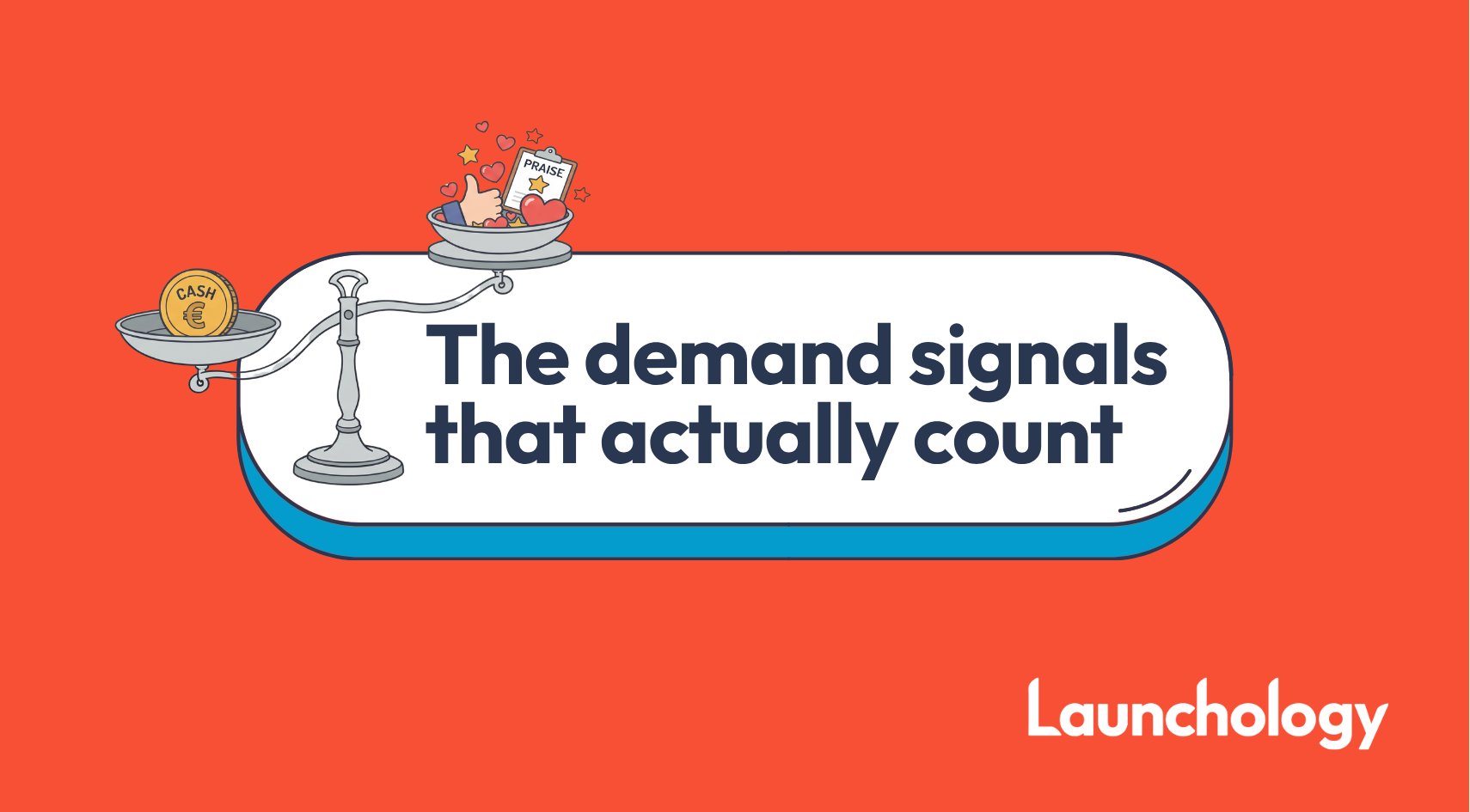
Notice that all five cost something. That’s not a coincidence, it’s the whole point. When you’re weighing whether your idea is real, put every signal on a set of scales and ask what it cost. A hundred free likes weigh nothing. One person who paid you fifty pounds weighs more than all of them.
Waitlists versus pre-orders, the line that matters
Let me pull out the one comparison that trips up the most founders, because it hides in plain sight. A waitlist and a pre-order look similar. Both are a list of interested people. But they measure two different things. A waitlist measures curiosity: “yes, tell me more.” A pre-order measures demand: “yes, here’s my money, don’t let me down.” The gap between those two lists is the gap between a hobby and a business.
The good news is that you can often turn one into the other with a single brave question. Instead of “join the waitlist”, try “reserve your place for five pounds, fully refundable.” Most of your 200 will vanish. The handful who stay are worth more to you than the whole list was, because they’ve just told you the truth. It stings, and it’s the cheapest, most valuable sting you’ll ever buy.
How to run a conversation that gives you truth, not politeness
You don’t need a paying customer to get an honest signal. You can get a lot of it from a conversation, if you run it properly. The trick, straight from The Mom Test, is to stop talking about your idea at all, and talk about their life instead. Your idea invites compliments. Their life gives you facts.
So anchor everything to what has actually happened, not what might. Don’t ask “would you use this?” Ask “how do you deal with this problem today?” Don’t ask “would you pay for that?” Ask “what have you tried, and what did it cost you?” The past is a witness. The future is a flatterer.
· Instead of “do you think this is a good idea?”, ask “tell me about the last time this problem actually bit you.”
· Instead of “would you buy it?”, ask “what are you using now, and what do you hate about it?”
· Instead of pitching, stay quiet and let them talk. In these conversations, you talking is you failing to learn.
· End with a real ask. “Can I come back to you when I have a first version?” is soft. “Would you pay a deposit to be first in the queue?” is the real test. If they say no, you’ve just saved yourself months.
And watch for the tell that matters most. It’s not what they say, it’s what they offer. When someone genuinely has the problem you’re solving, they lean in. They give you their time, introduce you to a colleague, ask when they can have it. When someone is just being nice, they give you compliments and then get on with their day. Learn to feel that difference and you’ll very rarely be fooled again.
Run the cheapest test that can still say no
If there’s one principle to take from all of this, it’s this: design the cheapest possible experiment that still gives reality a chance to say no. A survey where everyone says yes has told you nothing, because it was never able to say no. A landing page that asks for a small deposit, a pre-sell to ten people, a paid pilot with a single customer: these can all come back negative, and that’s exactly why they’re worth running. A test that can’t fail isn’t a test, it’s a comfort blanket.
You can run every one of these while you’re still holding down your job, on a budget of almost nothing. That’s the quiet advantage of getting demand right before you build: it’s the one stage of a startup that costs pennies and can save you years.
Before you build a thing
If you want a structured way to pressure-test your idea before you commit months to it, that’s exactly what the free Launchology Validation course is built for. It walks you through gathering the signals that actually count, running honest customer conversations, and reading the results without fooling yourself, all before you write a line of code. It’s free, and it’s built on the capital-side view of what real demand looks like. Start the free Startup Ideas & Validation course.